Mostrando entradas con la etiqueta May 21. Mostrar todas las entradas

sábado, 21 de mayo de 2011

21 de Mayo de 1879: Combate naval de Iquique ( español)


El combate naval de Iquique fue un enfrentamiento naval de la Guerra del Pacífico. Tuvo lugar en la bahía de Iquique, el día miércoles 21 de mayo de 1879.
En él se enfrentaron el monitor peruano Huáscar al mando del capitán de navío Miguel Grau Seminario y la corbeta chilena Esmeralda al mando del capitán de fragata Arturo Prat Chacón, quien resultó muerto en esta acción. En Chile se considera únicamente a este enfrentamiento como Combate naval de Iquique y tuvo como resultado el hundimiento de la corbeta chilena y el levantamiento del bloqueo del puerto de Iquique.
En el Perú se considera al enfrentamiento hasta Punta Gruesa con un solo nombre llamado Combate de Iquique incluyendo el enfrentamiento entre la fragata peruana Independencia y la goleta chilena Covadonga y tuvo como resultado el encallamiento de la Independencia en unos roqueríos.
  
Antecedentes 

Antes de la declaración de guerra, los chilenos decidieron atacar y el gobierno chileno decidió como estrategia movilizar su escuadra para bloquear el puerto peruano del Callao, esperando así encerrar allí a la escuadra del Perú para operar libremente en el litoral peruano o bien destruirla en un combate si se presentaba la ocasión. El contraalmirante Juan Williams Rebolledo, comandante en jefe de la escuadra chilena, rechazó este plan por considerar que sus naves no estaban en condiciones de emprender un ataque inmediato a El Callao pues carecía de víveres y combustible para la travesía. En su lugar, Williams prefirió bloquear el puerto de Iquique y desde allí hostilizar los puertos peruanos del Departamento de Tarapacá. La escuadra chilena parte el 3 de abril desde Antofagasta con destino a Iquique para establecer el bloqueo.

Chile declara la guerra al Perú y a Bolivia el sábado 5 de abril de 1879 y ese mismo día la escuadra chilena inicia el bloqueo del puerto de Iquique...
La escuadra chilena incursionó en los poblados peruanos de Pabellón de Pica, Huanillos (15 de abril) y Mollendo (17 de abril) bombardeando trenes y naves; luego bombardeó Pisagua (18 de abril) y destruyó Mejillones (29 de abril).
Debido a la presión del gobierno chileno, Williams es convencido de atacar el puerto del Callao. Para tal efecto, la escuadra chilena zarpó desde Iquique el viernes 16 de mayo en una expedición al Callao con todos los buques disponibles dejando el bloqueo de Iquique a cargo de los buques más antiguos de la escuadra chilena la corbeta Esmeralda al mando de Arturo Prat, la goleta Covadonga, al mando de Carlos Condell y el transporte Lamar. Debido a su mayor antigüedad, Prat quedó como jefe del bloqueo.
Para defender a las localidades peruanas del ataque chileno, el plan del Perú era terminar en El Callao las reparaciones de las naves de su escuadra y trasladar tropas y pertrechos hacia Arica, Iquique y demás puertos del Departamento de Tarapacá y enviar naves para traer desde Panamá armamento y municiones adquiridos en los Estados Unidos. Los comandantes peruanos Grau, More, y García y García, entre otros, estuvieron en desacuerdo con este plan ya que la Independencia estaba recién reparada y su tripulación no había hecho ejercicios navales mientras que el Huáscar no contaba con proyectiles capaces de penetrar el blindaje de los buques chilenos Cochrane y Blanco Encalada. A pesar de esta oposición, la escuadra peruana zarpó el mismo 16 de mayo desde El Callao hacia Arica llevando a bordo al presidente Mariano Ignacio Prado en la nave insignia Oroya.
Ambas escuadras se cruzaron en alta mar sin avistarse. En Mollendo el presidente Prado se enteró, por medio del vapor Ilo de la compañía PSNC, de que el grueso de la escuadra chilena se había retirado. En Arica se entera que habían dejado a las naves Covadonga, Esmeralda y un transporte a cargo del bloqueo de Iquique por lo que el presidente Prado decidió que el Huáscar y la Independencia navegaran hasta Iquique a romper el bloqueo, capturando o destruyendo a los buques chilenos.

Movimientos previos al combate

En la mañana del miércoles 21 de mayo, el bloqueo de Iquique era mantenido por la corbeta Esmeralda y la goleta Covadonga fondeadas ambas a 2,7 km al norte del faro del puerto. Por su parte el transporte Lamar se encontraba fondeado más cerca de la costa. A las seis y media de la mañana uno de los vigías de la Covadonga, la cual se encontraba de guardia, avistó columnas de humo acercándose desde el norte. Al reducirse la distancia, se identificó que dichas columnas de humo correspondían a los blindados peruanos Huáscar e Independencia. El comandante de la Covadonga, ordenó advertir la presencia del enemigo al comandante de la Esmeralda, Arturo Prat, con un cañonazo. Este, al escuchar la señal dispuso levar el ancla, hacer comer a la tripulación y tocar zafarrancho de combate. Además ordenó que la Covadonga se pusiera al habla para conferenciar y que se arrojara al mar, en un saco, la correspondencia para la escuadra chilena.
Los buques peruanos, al avistar las naves chilenas, izaron bandera de combate. El Huáscar se encontraba más cerca al puerto. El comandante Grau arengó a su tripulación:
"Tripulantes del Huáscar: Estamos a la vista de Iquique. Allí no solo están nuestros afligidos compatriotas de Tarapacá. Allí está el enemigo de la patria todavía impune. Ha llegado la hora de castigarlo. Espero que lo sabréis hacer cosechando nuevos laureles y nuevas glorias dignas de brillar al lado de Junín, Ayacucho, Abtao y el 2 de Mayo. ¡Viva el Perú!"

En 1866, cuatro naves peruanas defendieron posiciones chilenas en el canal de Challahué junto a la isla de Chiloé en el Combate de Abtao contra fuerzas españolas en la Guerra Hispano-Sudamericana.
Por su parte, Prat ordenó izar las señales: "reforzar las cargas", "venir al habla" y "seguir mis aguas" y a continuación arengó a su tripulación con las siguientes palabras:
"¡Muchachos!: La contienda es desigual, pero ánimo y valor. Nunca se ha arriado nuestra bandera ante el enemigo y espero que no sea ésta la ocasión de hacerlo. Por mi parte, os aseguro, que mientras yo viva, esa bandera flameará en su lugar y si yo muero, mis oficiales sabrán cumplir con su deber ¡Viva Chile!".

Terminada la arenga, la Covadonga llegó al habla y Prat le ordenó a Condell: "¡que almuerce la gente!, ¡reforzar las cargas!, ¡cada uno a cumplir con su deber!". Condell simplemente respondió: "¡all right!". Terminado lo anterior se sintió una explosión y una columna de agua y espuma se levantó cerca de ambos buques, el Huáscar había disparado su primer tiro. Se iniciaba el combate.
En tierra, la población puerto despertó con el primer cañonazo de la Covadonga y se dirigió a la playa para recibir a las naves peruanas que venían a liberarlos del bloqueo de Iquique.

Primera fase del combate

El transporte chileno Lamar izó bandera norteamericana y abandonó la bahía rumbo al sur. Durante 30 minutos el Huáscar se enfrentó solo a las dos naves chilenas, hasta la llegada de la Independencia. Los buques chilenos concentraron sus tiros sobre el Huáscar sin mayores consecuencias.
Los movimientos iniciales de la Esmeralda hicieron que averiaran sus calderas lo que redujo su andar desde los 6 kn a 3 kn. En atención a esto, Prat ubicó su nave frente a la población a distancia de 200 metros de la playa. En esta situación los cañonazos peruanos podrían afectar a la población y sumado a que las naves peruanas se encontraban en la entrada al puerto, el oleaje del mar no les permitía dirigir adecuadamente sus disparos.
Después de una hora de combate, las cuatro naves no presentaban daños importantes. A eso de las 11:30 horas la Covadonga, al mando de Condell, se dirigió al sur.
Grau ordena al comandante de la Independencia que siga a la Covadonga, la que puso rumbo al sur navegando pegada a la costa. En ese instante el combate se dividió en dos enfrentamientos, uno entre el Huáscar y la Esmeralda y el otro, que los historiadores chilenos denominarían combate naval de Punta Gruesa, entre la Independencia y la Covadonga.

Segunda fase del combate

Cuando el Huáscar se encontraba a unos 600 metros de la Esmeralda, un bote se le acercó, en él iba el capitán de puerto y de corbeta, Salomé Porras, junto al práctico Guillermo Checlay y el periodista Modesto Molina, quienes le informaron a Grau que la Esmeralda estaba protegida por una línea de torpedos fijos. Ante esta información, Grau decidió mantener una distancia de 500 metros de la corbeta, posición desde la cual abrió fuego.
Pasada una hora y media de combate, la Esmeralda no había sido impactada por ningún proyectil del Huáscar, sus tiros pasaban largos cayendo en la playa e hiriendo a la población. Cerca de las diez de la mañana, el general Juan Buendía, jefe de las tropas peruanas en Iquique, hizo llevar a la playa 4 cañones Blakely de montaña con los cuales empezó a disparar contra la Esmeralda. Una granada mató a tres hombres y otra hirió a otros tres. En total realizó 60 tiros y varios de fusilería. La situación se tornó insostenible para la corbeta chilena por lo que Prat decidió cambiar su ubicación 1.000 metros más al norte. Cuando iniciaba el movimiento una granada del Huáscar penetró por su costado de babor saliendo por estribor provocando un incendio en la cámara de oficiales que fue prontamente controlado.
Grau, al observar el movimiento de la Esmeralda, se dio cuenta de que la información de la defensa con torpedos era errónea, por lo que decidió atacar empleando su espolón. Enfiló su proa hacia el costado de babor de la Esmeralda. Prat trató de esquivar el golpe dando avante y cerrando la caña a babor no logrando esquivar el golpe que recibió a la altura del palo mesana sin mayores daños. Al chocar ambos buques el monitor Huáscar disparó sus cañones de diez pulgadas (300 libras) a corta distancia, produciendo la muerte de 40 o 50 marineros y soldados.
El espolonazo del Huáscar, a su vez, fue recibido con una tremenda descarga de las baterías de la Esmeralda y fuego de fusilería, lo que no causó mayor daño en el monitor.
Prat al ver la cubierta del buque enemigo a sus pies gritó:
"¡al abordaje, muchachos!"
En medio del estruendo, Prat pretendió abordar el Huáscar, saltó a la cubierta del Huáscar siendo seguido por el sargento Juan de Dios Aldea y el marinero Arsenio Canave quien perdió impulso y cayó al agua.
Una vez a bordo, Prat, armado con un sable y un revólver, avanzó hacia la torre de mando, en el trayecto hacia ella ultimó al oficial de señales, el teniente segundo Jorge Velarde. Al avanzar a babor de la torre de Coles, fue alcanzado por las balas en una de sus rodillas. Un marinero salió a cubierta, dándole un hachazo en la frente que le causó la muerte inmediata. A su vez el sargento Aldea cayó herido por una descarga de fusilería sobre la cubierta. Grau hizo un esfuerzo por salvar la vida de Prat pero ya era tarde.
El Comandante Grau quiso dar tiempo para que sus adversarios se rindieran, por lo que retira el Huáscar después del espolonazo. En la Esmeralda, tomó el mando el Teniente 1o. Luis Uribe Orrego, quien llamó a reunión de oficiales y deciden no rendirse. Al tiempo que un marino subía al palo de mesana para clavar las banderas.
Grau al ver que la tregua no daba resultado decide espolonear nuevamente a la Esmeralda, lanzándose a toda velocidad sobre ella, ahora por el costado de estribor. Uribe trató de maniobrar igual que Prat y logró presentar su costado en forma oblicua al espolón del monitor Huáscar, pero esta vez se abrió una vía de agua, ingresando a raudales a la santabárbara y a las máquinas. El buque quedó sin gobierno y sin más municiones que las que había en cubierta.
Nuevamente los cañones del Huáscar disparados a tan corta distancia que se mataron a varios tripulantes entre ellos a los ingenieros y fogoneros que salían a cubierta y arrasó la cámara de oficiales, convertida en enfermería. Se efectuó un segundo intento de abordaje por otros doce tripulantes chilenos, al mando del teniente primero Ignacio Serrano llevando rifles y machetes, el cual también resultó infructuoso, cayendo sobre la cubierta del monitor.
Al los 20 minutos se efectuó el tercer impacto con espolón en el sector del palo mesana acompañado de dos cañonazos, la corbeta se inclinó de proa y empezó a hundirse. A medida que el buque se inclinaba el Guardiamarina Ernesto Riquelme, gritando vivas a Chile disparaba el último cañonazo.
A las doce diez de ese día la Esmeralda desapareció de la superficie del mar.
En total, el Huáscar disparó 47 proyectiles y fue impactado por 6 bombas y 23 balas. Los chilenos acusaron 143 muertos. Los peruanos perdieron al teniente segundo Jorge Velarde y siete marineros resultaron heridos. Grau, antes de avanzar para reunirse con la Independencia, dispuso el salvataje de los 57 náufragos de la Esmeralda. Los corresponsales de guerra peruanos Modesto Molina del "El Comercio de Iquique", Julio Reyes de "El Comercio de Lima" abordo del Huáscar y José Rodolfo del Campo de "El Comercio de Lima" abordo de la Independencia, relatan en sus despachos que los sobrevivientes chilenos
".... dieron un ¡Viva el Perú! y encomiaron el valor y generosidad de los peruanos para con los rendidos"

Tercera fase del combate 

Los autores peruanos incluyen los eventos hasta Punta Gruesa como parte del Combate de Iquique.La Independencia se encontraba en persecución de la Covadonga, quien pegada a la playa en la bahía de Chiquinata iba rumbo al sur del puerto de Iquique, hasta que llegan a la última caleta donde la Independencia encalla en los roquerios de "Punta Gruesa". 

El comandante Condell ordena retroceder y bombardear la Independencia la cual se defendió aun inundada y enviando a los náufragos en botes hacia la playa.

El Huáscar, tras rescatar a los 57 sobrevivientes de la Esmeralda, avistó a la Independencia a las 2:20 pm a 9 millas de distancia y llegó frente a ella a las 3:10 pm. La encontró varada y con solo 20 tripulantes a bordo, entre ellos More, ya que el resto había desembarcado en botes. El blindado peruano continuó la persecución de la Covadonga durante tres horas, hasta que Miguel Grau, convencido que la distancia que lo separaban de ella no podía acortarse antes de la puesta del sol, decidió regresar en auxilio de la Independencia. Grau estimó entonces que la pérdida de la fragata era total y envió las embarcaciones del Huáscar por los tripulantes que aún se encontraban a bordo dando la orden de incendiar el buque.

Tumbas de Prat y Serrano en Iquique.
Los sobrevivientes de la Esmeralda fueron entregados a las autoridades militares del puerto de Iquique. Los oficiales sobrevivientes fueron conducidos a la localidad de Tarma, en Perú.
Luego del combate, el Almirante Grau ordenó que los objetos personales de Prat, su diario personal, uniforme, espada entre otros, fueran devueltos a la viuda de Prat. Junto con ellos, Carmela Carvajal recibió una carta del Almirante peruano. En esta carta Grau recalca la calidad personal y la hidalguía de su rival. En respuesta, Carmela Carvajal le escribió una carta agradeciendo este gesto. Este hecho sumado al rescate de los sobrevivientes de la Esmeralda hicieron ganar a Grau el apodo de "El Caballero de los Mares".
Sobre la situación de los sobrevivientes de la Esmeralda, Jorge Hunneus del Ministerio de Asuntos Exteriores de Chile escribe al Vice Cónsul Británico en Iquique expresando la generosidad con el cual el Perú trata a los marinos prisioneros y la cual espera corresponder.
Los cadáveres de Prat y Serrano fueron enterrados gracias a la gentileza del ciudadano español Eduardo Llanos, junto a otros miembros de su colonia, el jueves 22 de mayo en el cementerio de Iquique, corriendo el español con todos los gastos.
A Chile la noticia llegó a Valparaíso por el cable submarino. El sábado 24 de mayo recién se conocieron en Santiago los detalles del combate en Iquique y la muerte de Prat y, además, el hundimiento de la Independencia. Desde ese momento se produjo en Chile un avivamiento del patriotismo y muchos chilenos acudieron voluntariamente a los cuarteles para enrolarse y participar en el conflicto.

Homenajes

Monumento a Miguel Grau, en Pucallpa.
En el año 1888 los restos del comandante Arturo Prat fueron trasladados a Valparaíso, donde se les dio sepultura en un monumento construido por sufragio popular. En este monumento, descansan los máximos héroes navales chilenos, y es ahí donde cada año, en el día de las glorias navales, con la presencia del presidente de la república, se honra con desfiles militares a la figura de Prat y su tripulación.
Monumento a los Héroes de Iquique, en Valparaíso.
El almirante Miguel Grau Seminario es recordado tanto en Perú como en Chile por su hidalguía y caballerosidad en combate. Algunas calles en Chile llevan el nombre de Almirante Grau. Sus acciones durante la Guerra del Pacífico lo convirtieron en el mayor héroe naval de la marina de guerra del Perú. Miguel Grau también es considerado héroe naval en Bolivia.


Buques enfrentados


Corbeta Esmeralda

La Esmeralda era una corbeta de madera de 850 t de desplazamiento construida en 1855. Su armamento estaba compuesto por 12 cañones de 40 libras. Su sistema de propulsión era mixto, máquina a vapor y vela. Al momento de entrar en combate sus máquinas estaban en mal estado de mantenimiento y sólo eran capaces de propulsar el buque a una velocidad de 4 nudos, los que se redujeron a 2 nudos al estallar sus calderas.

Monitor Huáscar

El Huáscar, es un buque blindado de 1.745 t de desplazamiento construido en 1865. Cuenta con un blindaje de 4,5 pulgadas de espesor y su armamento principal estaba constituido, en esa época, por 2 cañones de avancarga Armstrong de 300 libras ubicados en una torre giratoria blindada, además de 2 cañones de a 40 pdr, uno de 12 pdr y una ametralladora Gatling de 0,44 pulgadas. Su sistema de propulsión era también mixto, máquina a vapor y vela siendo capaz de alcanzar una velocidad máxima, el día del combate, de 10,5 nudos.

May 21, 1879 : Battle of Iquique ( English )


 The Battle of Iquique was a confrontation that occurred on May 21, 1879, during the naval stage of the War of the Pacific, a conflict between Chile and Peru and Bolivia. The battle took place off the, by then, Peruvian (currently Chilean) port of Iquique. The Peruvian ironclad Huáscar, commanded by Miguel Grau Seminario, sank the Esmeralda, a Chilean wooden corvette captained by Arturo Prat Chacón, after four hours of combat.
  
Background

The Bolivian government had threatened to confiscate and to sell the Antofagasta Nitrate & Railway Company, a mining enterprise with Chilean and British investors, by a decree on February 1, 1879. In response, the Chilean government sent a small military force which disembarked and seized control of the port of Antofagasta on February 14. This event made Bolivian President Hilarión Daza declare war on Chile, and also forced Peru to honor a secret 1873 treaty with Bolivia. Although Peru tried to negotiate and to stop the imminent conflict, Chile, knowing of this pact, declared war on both Peru and Bolivia on April 5. Another small Chilean force took control of the city of Calama after its victory in the Battle of Topater on March 23.
From the beginning of the conflict, both sides clearly knew that control of the sea was the key to obtaining victory. Whichever country controlled the sea could freely transport troops and land them at any strategic point. So, during the first year of the war, Chilean strategy focused on destroying the Peruvian Navy.
In order to achieve this goal, the Chilean naval commander, Juan Williams Rebolledo, planned to sail north with his entire fleet, trying to engage the Peruvian Navy at Callao and achieve domination of the sea once and for all. The main ships of the Chilean Navy were sent towards the Peruvian port of Callao. Two old, wooden ships, the corvette Esmeralda and the schooner Covadonga, commanded by Captains Arturo Prat and Carlos Condell respectively, were left blockading the Peruvian port of Iquique.
However, as the Chilean Navy steamed north towards Callao, two ironclad ships of the Peruvian Navy steamed south from Callao, unseen. These ships were the monitor Huáscar and the armored frigate Independencia, commanded by Rear Admiral Miguel Grau (then a Captain), the commanding officer of the Peruvian Navy and Captain Juan Guillermo More.
  
Forces in combat

The wooden corvette Esmeralda was constructed on 1854 in Henry Pritcher's shipyard, arriving at Valparaíso in 1856. This vessel was named Esmeralda after the frigate of the same name captured by Lord Cochrane at El Callao in 1820. The Esmeralda displaced 854 tons, and was armed with twenty 32-pound cannons and two 12-pound cannons. In 1868, its artillery was replaced with twelve strayed cannons of 40 pounds, and four 40-pound Withworth cannons.
The Peruvian ironclad Huáscar was built in 1865 in the Laird Brothers' shipyard. The Huáscar displaced 1,180 tons, and was armed with two cannons of 300 lbs., two cannons of 40 lbs, one cannon of 12 lbs and one Gatling machine gun. This ship could reach a speed of 11 knots.

 Before the battle

It was 21 May 1879, 6:30 in the morning, when the fog cleared, Covadonga's lookout shouted: "Smoke to the north!". But, owing to thick marine fog, they were not able to identify the newly arrived ships, but after a few moments they thought it was the Peruvian squadron coming back.
At 6:45 a.m., a sailor by Condell's side asked for the telescope, and in a moment of clarity he observed the warships' rigging and said to Condell: "It's the Huáscar and the Independencia". "What basis do you have to assert that?" asked Condell, and the sailor answered "From the shape of the platform on top of the foremast".
Immediately Condell ordered a shot to be fired in the air to warn the Esmeralda, still anchored in the port. The ships were indeed the Independencia and the Huáscar.
In that same moment, the Peruvian admiral Grau roused his crew:
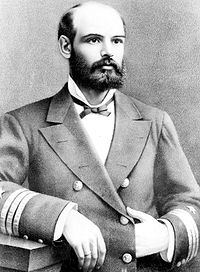
Commander Miguel Grau Seminario.
"Crewmembers and Sailors of the Huáscar, Iquique is at sight, there are our afflicted fellow countrymen from Tarapacá, and also the enemy, still unpunished. It's time to punish them! I hope you will know how. Remember how our forces distinguished in Junin, the 2nd of May, Abtao, Ayachucho and other battlefields, to win us our glorious and dignified independence, and our consecrated and brilliant laurels of freedom, and as Commandant of the Navy will never let Peru be defeated. For our fatherland, Long Live Peru!"
Carlos Condell de la Haza warned Prat, and he, seeing the difference between their forces and the enemies', ordered to hoist the signal: "reinforce the charge", "come to the talks" and "follow my waters(follow his course)" and then inspired the crew with the following words:
Commander Arturo Prat Chacón
Lads, the battle will be unfair, but, cheer and have courage. Never has our flag been hauled down before the enemy and I hope this will not be the occasion for it to happen. From my part, I assure you that as long as I live, this flag will blow in its place, and if I die, my officers will know how to fulfill their duties. Long Live Chile!
After the speech, the Covadonga came to an halt and Commander Prat then told the crew of the Esmeralda and to the crew of the Covadonga led by Commander Condell: "For lunch people, Strengthening loads, each to his duty!". Condell simply replied, "All right, sir!" A young ordering bugler at the same time was sounding the call to battle. After this everyone felt an explosion and a plume of water and foam up on the two ships, the Huascar had fired its first shot. The battle had begun.
On land, people awoke to the first shot of the Covadonga's gun and went to the beach to get a Peruvian craft coming to lift the blockade.

First phase of the battle

At 8:15, the first volley hit between the ships, and Prat ordered the Esmeralda to start moving, followed by the Covadonga. The transporter Lamar was ordered (by Prat) to retreat to the South.
At 8:25 a second volley fell and a shot from the Huáscar hit fully on the starboard (right) side, passed through Esmeralda's side, killing the surgeon Videla, beheading his assistant, and mortally wounding another sailor. Condell changed his course and went behind the Lamar. Grau ordered the Independencia to block Covadonga and Lamar's way. Prat observed Condell's action and asked himself: "What is Condell doing?" Condell ignored Prat's order and followed the Lamar, but the warship did get away from the Covadonga, and the Independencia under control of Juan Guillermo More followed him.
The Independencia pursues the Covadonga, while the Huáscar finished the Esmeralda. Prat quickly positioned the ship in front of the coast, 200 meters from it, forcing the Huáscar to shoot with a parabolic trajectory to avoid hitting the Peruvian village, whose people gathered in crowds to see the battle.

Second phase of the battle

General Buendía, commander of the Peruvian garrison of Iquique, had artillery cannons placed on the beach and sent an emissary in a fast rowing boat with a warning to the Huáscar that the Esmeralda was loaded with torpedoes. Grau stopped 600m (660 yd.) from her and began shooting with the 300-pound cannons, not hitting her for an hour and a half, owing to the Peruvian sailors' inexperience in the handling of the monitor's Coles turret. The Chilean crew answered with their 30-pound cannons and gunfire, shots that rebounded uselessly from the Huáscar's plated armour.
At the coast, the Peruvian Army garrison in the town installed a cannon battery manned by gunners and bombardiers, and began to bomb the Chilean ship. A grenade reached her, killing three men. Prat order the warship to move, to forcing the engenine one of the boilers exploded, so the ship's speed dropped to 2 knots (her engine was defective by age and lack of maintenance). This move allowed Grau to see the absence of the torpedoes that supposedly filled the Esmeralda. One of Huáscar's shots hit directly on board, beheading the ordering bugler and mutilating the gun crews.
The position of the Esmeralda was desperate when it began to receive both Huáscar and Iquique's beach's cannon shots. Even Grau from his armoured tower exclaimed:
“It's remarkable how these Chileans fight”
, impressed by the courage shown by the enemy.
Grau, seeing the useless slaughter that was taking place in the dismantled and disgraced corvette and wanting to end the combat, which had been nearly 4 hours long until that moment, ordered his ship to ram into the Esmeralda. Prat tried to avoid the blow by giving the rod forward and closing a port not managed to sidestep the blow to the mizzen mast height without further damage. When the ships collided, the Huáscar fired their ten inches (300 pounds) cannons at close range, causing the deaths of 40 or 50 sailors and marines.
By then, Prat raised his sword and cried his final order:
"Let's board, boys!"
, but due to the roar of the battle only Petty Officer Juan de Dios Aldea and Seaman Arsenio Canave heard it, and both of them and Prat jumped aboard the other ship. Arsenio unfortunately slipped and fell down because of the impact, so only the two officers got to the monitor. Petty Officer Aldea, by then armed with a boarding hatchet and a pistol, received a burst from the artillery tower and fell mortally injured. Only Prat continued advancing armed with a sword and a pistol. Grau gave the order to capture the Chilean captain alive.
Once on board, Prat, walked up to the conning tower, on the journey towards he killed the Peruvian Signal Officer, Second Lieutenant Jorge Velarde, but while moving to the Coles Tower a sailor from the artillery tower struck him dead with a shot in the forehead with a rifle in his hand.
Sinking of the Esmeralda.
After the first boarding attempt failed, Grau wanted to give his opponents time to surrender. In the Esmeralda Lieutenant Luis Uribe Orrego by now the ship's acting Captain, then called the official meeting and decided not to surrender to Peru. While this was happening a sailor climbed the mizzen-mast to nail down the Chilean national flag.
Grau was soon notified that the truce did not work again and decided to ram again the Esmeralda, rushing at full speed on it, now for the starboard side. Uribe tried to maneuver like Prat and managed to present his side at an angle to spur the monitor Huáscar, but this time he opened a water route, entering pouring into the powder magazine and machines. The ship had a crew shortage and without more ammunition than he had on deck.
The Huáscar again fired guns at such close range that killed several crew members including engineers and firemen who went up on deck and washed away the officers' mess room, which was then also the ship's clinic. Sublieutenant Ignacio Serrano cried again
"Stand by for boarding!"
and he boarded the Huáscar with eleven more men, armed with manchetes and rifles but which was also unsuccessful, falling on the deck of the monitor for Gatling guns and the monitor's crew, some dying immediately due to bullet wounds sustained. Ignacio Serrano was then the only survivor and had received several shot wounds in the groin. Grau quickly had him picked up and carried to the infirmary in a state of shock, where they left him next to the dying petty officer Aldea.
20 minutes after was the third ram, this time in the sector of the mizzen mast accompanied by two guns, the corvette leaned forward and began to sink. When the Esmeralda was sinking The last cannon shot was fired by Midshipman Ernesto Riquelme, while the main deck was going underwater the Huascar crew heard screams of "Long Live Chile! Glory and Victory!" from the ship's sailors. The Chilean flag was the last part of the warship to go underwater, still flying and nailed to the mizzen-mast. It was 12.10 pm at midday, and that was when Grau realized that Cmdr. Prat had already died in the infirmary.

Third phase of the battle

See also Battle of Punta Gruesa for a more detailed account
The Independencia was in pursuit of Covadonga, which when it was stuck to the beach in the bay of Chiquinata the latter was heading south of the port of Iquique, until the former came on the rocks and shallow waters of Punta Gruesa. Commander Condell ordered an attack on the Independencia which resulted in it being sunk and its crew fleeing using its lifeboats, with only 20 of its crew left.
Grau ordered the rescue of the 57 survivors of the Esmeralda, but saw the Independencia at 2:20 pm to 9 miles away and arrived in front of her at 3:10 pm. He found it stranded on the shallow water and with the 20 surviving crew members, including More, since the rest had landed in boats on the shore. The Peruvian armored ship continued the pursuit of Covadonga for three hours until Miguel Grau, convinced that the distance that separated him it could not be shortened before sunset, he returned to the aid of Independencia. Grau estimated then that the loss of the frigate was complete and sent back to Huáscar the crewmen on board were still giving the order to burn it.

Epilogue

After the battle, Rear Admiral Grau gave orders that Prat's personal objects (diary, uniform and sword among others) were to be returned to his widow. Carmela Carvajal received them, as well as an attached letter from the Peruvian Admiral, affirming his rival's personal qualities, his gentility and his high moral values.
In Chile, news reached the submarine cable in Valparaiso. On Saturday May 24 the Chilean Navy General Staff, Naval High Command and Admirality Commission convened a special meeting about the events in Iquique and Punta Gruesa on the 21st, and sent reports of the battles to the War Department, resulting in a mass draft being ordered. Since that time Chile was in a revival of patriotism and many Chileans went voluntarily to the barracks and the naval stations to enlist and participate in the conflict.

Aftermath

The Naval Battle of Iquique was a Peruvian victory; the blockade on Iquique was lifted and Chile temporarily left the area. However, Peru's loss of the Independencia, one of its most powerful warships, in the following battle of Punta Gruesa was strategically costly, while Chile only lost one of its oldest wooden warships. Also, Cpt. Prat's sudden death while on duty inspired thousands of Chilean youth to join the army and the navy. This is considered by Chilean historians to be one of the most important factors leading to victory in the war. Years later the figure of Prat became so popular that newspapers started to talk about "Pratiotism" and "Patriotism".
And it was not just Prat that was being honored. Grau, also now known as the "Gentleman of the Seas" due to his actions in the battle and later naval actions, is honored in both Peru and Bolivia as the countries' greatest naval hero.